The ESG reporting platform built for enterprises that can't afford to get it wrong
SECR. CSRD. UK SRS. CDP. The frameworks keep multiplying, but most platforms weren't built for any of them. Altruistiq is the ESG reporting software built for enterprises that need their data to hold up.
Hit every deadline. Answer every question. From one platform
Altruistiq is ESG reporting software, and the carbon accounting software that sits underneath every framework you report against. The same calculation engine powers your SECR disclosure, your CSRD supply chain data, your CDP submission, and your supply chain decarbonisation programme. Same data. Same methodology. Same answers, every time.
Sustainability teams spend more time fixing data than using it. Spreadsheets that don't reconcile. Point solutions running on different methodologies. Numbers you can't defend when someone asks how you got there. Altruistiq changes that with one source of truth that holds up wherever you need it.
What our customers achieve with AQ
Altruistiq customers are shaping business decisions with climate data
“There’s been so much joy for me in being able to visually tell a story through the data. I think for me it’s about being able to communicate impact in a way that anyone can understand.”
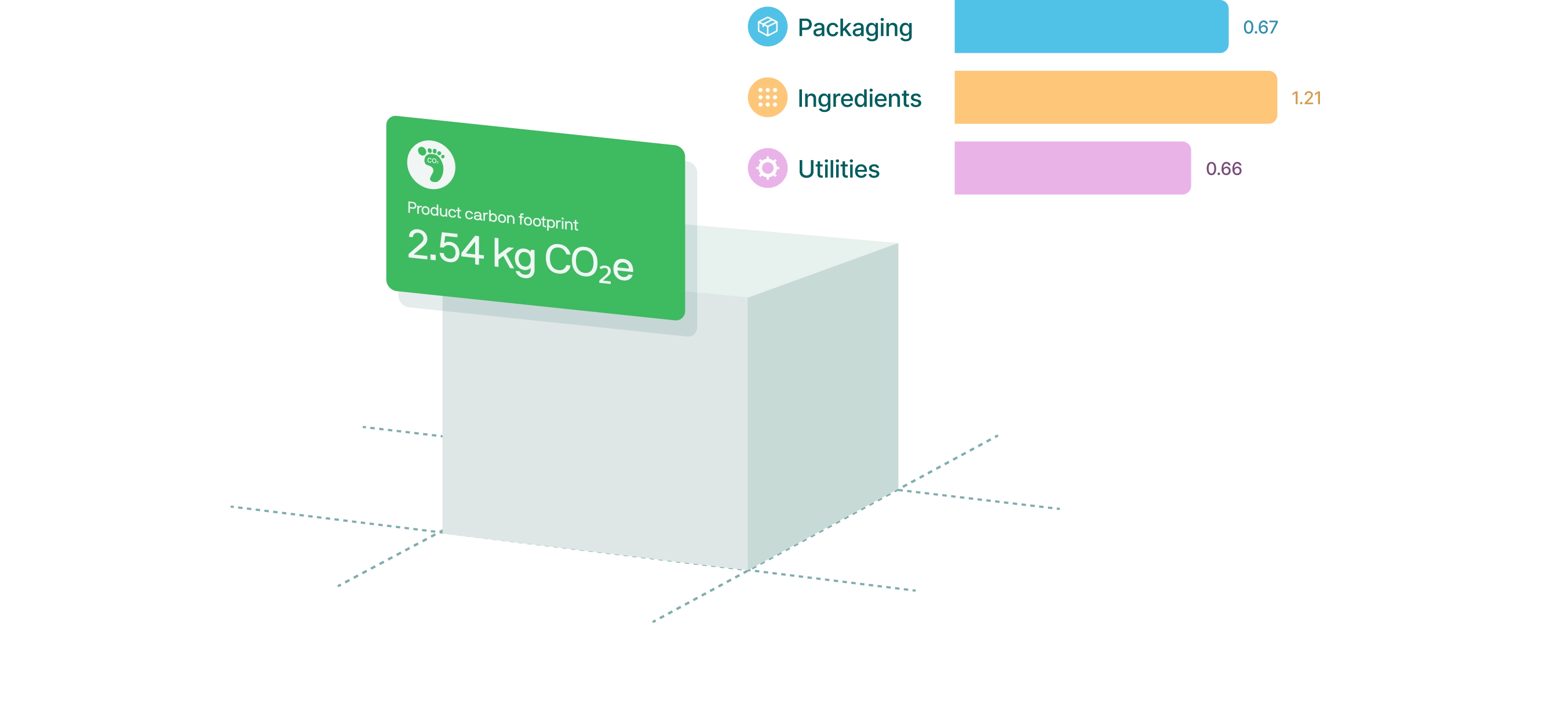
"We can now see the footprint of a bottle of ketchup, broken down into its components. It's completely new information that used to take months to collect. That is just transformative."
“We're seeing analysis like we've never seen before with the Altruistiq platform. I can actually see the bottle of ketchup and the impact broken down into components. It's completely new information that used to take months to collect.”
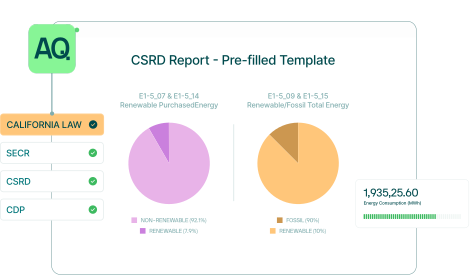
Meet every deadline with data you can defend. Altruistiq calculates Scope 1, 2, and 3 emissions to GHG Protocol standards – audit-ready, methodology-locked, and consistent year on year.
Engage
Supply chain · Supplier data · Product carbon footprinting
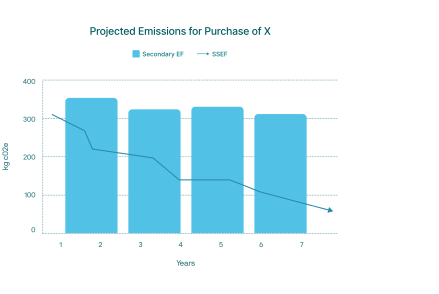
Get primary data from the suppliers that matter, not spend-based estimates. Suppliers calculate and share in days. Every submission is quality-scored. Through the PACT network, the data you collect feeds your CSRD, CDP, and SBTi obligations at the same time.
Reduce
SBTi targets · Net zero planning · Decarbonisation tracking
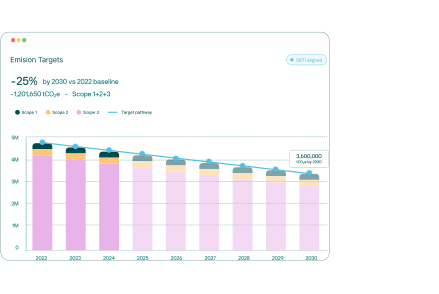
Turn data into a decarbonisation roadmap. Model reduction scenarios against your SBTi targets, identify where the biggest cuts are, and track real progress as supplier and operational data updates – so you can show decarbonisation happening, not just promised.
47%
average supplier response rate vs. 10% industry average
85%
faster to audit-ready data
180,000+
environmental factors
800+
businesses in the PACT network
45M+ tCO2e
measured globally
ESG Reporting
ESG Reporting
What is ESG reporting software, and why is it getting harder?
ESG reporting software helps enterprises collect, calculate, and disclose their environmental, social, and governance data across multiple regulatory and voluntary frameworks.
The environmental pillar – greenhouse gas emissions, energy use, climate risk – has become the most technically demanding area of ESG, and the compliance landscape keeps expanding.
For large UK enterprises, ESG reporting today means navigating SECR, CSRD, UK SRS, and CDP simultaneously. Each with different data requirements, different deadlines, and different levels of scrutiny. Underlying all of them is a carbon accounting challenge: the data required is hard to collect, harder to verify, and almost impossible to manage across siloed systems.
That's the problem Altruistiq solves.
SECR reporting: what UK enterprises need to know
What is SECR reporting?
Streamlined Energy and Carbon Reporting (SECR) is the UK's mandatory carbon reporting framework for large companies. Organisations meeting two of three thresholds (250+ employees, £36m+ turnover, or £18m+ balance sheet) must disclose their energy consumption and greenhouse gas emissions in their annual report every year.
SECR covers Scope 1 and Scope 2 emissions as a minimum, with Scope 3 strongly encouraged. Emissions must align with the GHG Protocol, trace to underlying activity data, and be accompanied by an intensity metric. SECR has applied since financial years starting on or after 1 April 2019.
Why SECR is harder than it looks
Energy data scattered across sites and suppliers. Different teams using different emission factors. Activity data that doesn't map to GHG Protocol categories. A methodology trail that's difficult to reconstruct when auditors ask.
Altruistiq's Corporate Carbon Footprint product automates collection across your organisation, applies GHG Protocol-aligned emission factors from a verified library, and produces a traceable, audit-ready calculation. Methodology locked and consistent year on year. When your SECR baseline evolves into full Scope 3 reporting for CSRD or CDP, nothing needs to be rebuilt.
CSRD reporting: what it requires and whether it applies to your UK business
What is CSRD?
The Corporate Sustainability Reporting Directive (CSRD) is the EU's mandatory sustainability reporting framework, replacing the NFRD. It requires in-scope companies to disclose against the European Sustainability Reporting Standards (ESRS) – covering climate, biodiversity, social factors, and governance through a double materiality lens – with independent assurance required.
Does CSRD apply to UK companies?
CSRD does not directly apply to most UK-registered companies following Brexit. However, UK companies are in scope as subsidiaries of in-scope EU parent companies, as companies with securities listed on EU-regulated markets, or if their EU operations bring them into the consolidation scope of an in-scope EU group.
Even outside direct scope, UK businesses supplying into European value chains should expect formal data requests from CSRD-obligated customers. This includes requests for Product Carbon Footprints calculated to PACT-conformant methodology.
⚠︎ The EU's Omnibus simplification package (2025) may reduce the number of companies in direct scope. Confirm your current obligation with legal counsel. Last reviewed March 2026.
What does CSRD require in terms of data?
CSRD's ESRS E1 climate standard requires all 15 GHG Protocol Scope 3 categories. The hardest: Category 1 (purchased goods and services), which requires primary activity-level data from suppliers – not estimates, not spend proxies.
Altruistiq's Supply Chain Engagement module is built for this. Suppliers get free accounts with guided calculation tools. Every submission is quality-scored. Through the PACT network, Altruistiq customers achieve an average supplier response rate of 47%, compared to an industry average of 10%.
UK SRS: the emerging UK Sustainability Reporting Standard listed enterprises should prepare for now
What are the UK Sustainability Reporting Standards?
The UK Sustainability Reporting Standards (UK SRS) are national disclosure standards being developed by the FRC, based on IFRS S1 and S2. When mandated, UK SRS will require large listed companies to disclose climate-related financial information in their annual reports: Scope 1, 2, and 3 emissions, climate risk assessments, and TCFD-aligned transition plans.
Timelines and thresholds remain subject to consultation. But listed companies not already building the data foundations for this are taking a risk they don't need to take.
UK SRS requirements overlap heavily with CSRD ESRS E1. Companies investing in a robust carbon data infrastructure now (covering SECR and ready for UK SRS) won't need to rebuild when the standard lands. Altruistiq's single calculation engine means the same data feeds every disclosure framework.
Last reviewed March 2026
CDP & SBTI
CDP, SBTi, and voluntary reporting: connected to mandatory frameworks
CDP remains essential for enterprises with institutional investors, and the underlying data requirements are the same as SECR and CSRD. Build the foundation once; voluntary disclosure follows.
SBTi's net zero standard requires Scope 3 coverage above 67% of total emissions – making supply chain engagement mandatory for companies with SBTi targets. Altruistiq's Net Zero Planning capability maps your baseline to reduction pathways, models SBTi-aligned scenarios, and tracks real progress as data updates.
For GRI reporters: Altruistiq's single calculation engine keeps your GRI environmental disclosures consistent with every other framework you report against.
WHY ALTRUISTIQ
Why leading enterprises choose Altruistiq
One calculation engine. Zero methodology conflicts
Meet every deadline with data you can defend. Altruistiq calculates Scope 1, 2, and 3 emissions to GHG Protocol standards – audit-ready, methodology-locked, and consistent year on year.
Built for the hard part of Scope 3
Our environmental factor library covers 180,000+ factors across food, beverage, agriculture, and manufacturing. PACT network exchange means suppliers share once, multiple customers receive.
Audit-ready by design
Every emission factor, source, and calculation step is recorded and accessible. Third-party assurance (required under CSRD, expected under UK SRS) is straightforward because the audit trail is built in.
70% less manual work. 85% faster to audit-ready
Customers report a 70% reduction in manual data work and reach audit-ready footprints 85% faster (Altruistiq customer data, 2025). Automated collection, AI-powered quality scoring, built-in workflow tools.
No per-seat pricing
Every team that needs sustainability data – procurement, finance, R&D, marketing – gets access. Without budget battles and access requests.
Start where you are. Scale as you go
Begin with your SECR baseline. Add supply chain engagement when Scope 3 becomes a priority. Expand to product carbon footprinting when PCF requests arrive. One platform that grows with your programme.
See how enterprises manage ESG reporting with Altruistiq.
Book a 30-minute demo. We'll show you how your specific obligations map to Altruistiq's platform and what a credible data foundation looks like for an organisation like yours.
Scope 1, 2, and 3 emissions calculated to GHG Protocol standards. Satisfies SECR, CSRD, UK SRS, CDP, and SBTi simultaneously. Audit-ready. Updated in real time.
Supply Chain Engagement
Primary emissions data from your supply chain at scale. Free supplier accounts. Quality-scored submissions. PACT-conformant exchange.
Product Carbon Footprint
Ingredient- and product-level PCFs for CSRD ESRS E1, customer disclosures, and on-pack claims. The deepest environmental factor library in the industry for food, beverage, and agriculture.
What our customers achieve with AQ
Trusted by enterprises managing sustainability at scale
“There’s been so much joy for me in being able to visually tell a story through the data. I think for me it’s about being able to communicate impact in a way that anyone can understand.”
"We can now see the footprint of a bottle of ketchup, broken down into its components. It's completely new information that used to take months to collect. That is just transformative."
“We're seeing analysis like we've never seen before with the Altruistiq platform. I can actually see the bottle of ketchup and the impact broken down into components. It's completely new information that used to take months to collect.”
SECR vs CSRD vs UK SRS: what each framework requires
SECR
CSRD
UK SRS
Who it applies to
Large UK companies (250+ employees, £36m+ turnover, or £18m+ balance sheet)
EU companies + UK subsidiaries of EU parents; UK companies with EU listings
Large UK-listed companies (thresholds TBC)
Scope 1 & 2
Required
Required (ESRS E1)
Required
Scope 3
Encouraged
Required (all 15 categories)
Required
Supply chain data
Not required
Required (Category 1 primary data)
Expected
Third-party assurance
Not required
Required
Expected
Supply chain data
Not required
Required
Required
Supply chain data
Mandatory
Mandatory (when enacted)
Mandatory
Last updated March 2026. Sources: UK Government SECR guidance; EU CSRD/ESRS; FRC UK SRS consultation.
SECR
CSRD
UK SRS
Who it applies to
Large UK companies (250+ employees, £36m+ turnover, or £18m+ balance sheet)
EU companies + UK subsidiaries of EU parents; UK companies with EU listings
Large UK-listed companies (thresholds TBC)
Scope 1 & 2
Required
Required (ESRS E1)
Required
Scope 3
Encouraged
Required (all 15 categories)
Required
Supply chain data
Not required
Required (Category 1 primary data)
Expected
Third-party assurance
Not required
Required
Expected
Transition plan
Not required
Required
Required
Voluntary / mandatory
Mandatory
Mandatory
Mandatory (when enacted)
Last updated March 2026. Sources: UK Government SECR guidance; EU CSRD/ESRS; FRC UK SRS consultation.
Ready to build an ESG reporting foundation that holds up?
Book a 30-minute demo. We'll show you how Altruistiq maps to your specific obligations and what it looks like to move from fragmented data to a single source of truth.
ESG reporting software helps companies collect, manage, calculate, and disclose their environmental, social, and governance data. For the environmental pillar, this means automating emissions data collection, calculating greenhouse gas emissions to recognised standards (GHG Protocol, ISO 14064), and producing outputs that satisfy SECR, CSRD, UK SRS, and CDP requirements.
What is SECR reporting?
Streamlined Energy and Carbon Reporting (SECR) is the UK's mandatory annual carbon reporting framework for large companies. Organisations meeting two of three thresholds (250+ employees, £36m+ turnover, or £18m+ balance sheet) must disclose Scope 1 and Scope 2 emissions in their annual reports, with Scope 3 strongly encouraged. Emissions must align with the GHG Protocol and include an intensity metric.
Does CSRD apply to UK companies?
CSRD does not directly apply to most UK-registered companies following Brexit. UK companies are in scope as subsidiaries of in-scope EU parents, as companies listed on EU-regulated markets, or if EU operations bring them into an in-scope EU group's consolidation. Even outside direct scope, UK companies supplying into Europe face indirect requirements as CSRD-obligated customers request supplier emissions data. The EU's Omnibus simplification (2025) may reduce direct scope – confirm with legal counsel. Last reviewed March 2026.
Our auditors are strict. How do we prove the numbers are right?
Every figure traces back to its source activity data, emission factor, and methodology in a single click. Full data lineage is built in, not bolted on. Our calculation engine is ISO14064-1 assured, and we maintain a 100% assurance pass rate, including with Big Four auditors. If auditors raise methodology questions, our team provides technical support at no cost.
What are the UK Sustainability Reporting Standards?
UK SRS are national sustainability disclosure standards being developed by the FRC, based on IFRS S1 and S2. When mandated, they will require large listed companies to disclose Scope 1, 2, and 3 emissions and TCFD-aligned transition plans in their annual reports. Timelines remain subject to consultation.
What is carbon accounting?
Carbon accounting is the process of measuring, tracking, and reporting an organisation's greenhouse gas emissions to recognised standards (primarily the GHG Protocol) covering Scope 1 (direct), Scope 2 (energy-indirect), and Scope 3 (value chain) emissions in tCO2e. It is the foundation for ESG reporting, net zero commitments, and supply chain decarbonisation.
What is the difference between SECR, CSRD, and UK SRS?
SECR is a UK mandatory framework for annual energy and carbon disclosures for large companies. CSRD is an EU mandatory framework requiring detailed sustainability disclosures including full Scope 3 supply chain data, applicable to UK companies with EU operations or EU parent companies. UK SRS is an emerging UK mandatory standard for climate-related financial disclosures for listed companies, aligned to IFRS S1/S2 and TCFD. All three require credible GHG emissions data – making a single, consistent methodology essential for companies with obligations across more than one framework.
How does Altruistiq support multiple ESG frameworks from one platform?
Altruistiq runs every use case on the same calculation engine: SECR, CSRD, UK SRS, CDP, supply chain engagement, and product carbon footprinting. The same underlying data produces consistent outputs across every framework: one source of truth, no methodology conflicts, one audit trail that supports every disclosure you need to make.
What about data security?
SOC-2 certified. ISO27001 compliant. Your data never leaves your secure instance with Evie AI.
Push-based data transfer (more secure – you control what we receive)
Your data security is non-negotiable
Row-by-row audit trail for full transparency
AWS-powered infrastructure
SSO ready for enterprise access control
With Evie, your data stays in your secure instance, it’s never sent externally for AI processing. You have complete control.
What about data security?
SOC-2 certified. ISO27001 compliant. Your data never leaves your secure instance with Evie AI.
Push-based data transfer (more secure – you control what we receive)
Your data security is non-negotiable
Row-by-row audit trail for full transparency
AWS-powered infrastructure
SSO ready for enterprise access control
With Evie, your data stays in your secure instance, it’s never sent externally for AI processing. You have complete control.
















.webp)