


Upcoming events
%20(1).jpg)

State of Sustainability: London End-of-Year Gathering
December 2, 2026
,
Holborn, London
Join Altruistiq and fellow sustainability leaders for an evening of practical insight, candid conversation and networking in London. We’ll reflect on the year’s biggest shifts and look ahead to the priorities shaping sustainability across business and supply chains.
Browse the full library


The three bedrock skills to future-proof your sustainability career
The sustainability function is under pressure from three directions: functional migration to procurement and finance, automation of core workflows, and a retreat from ambitious blue-sky thinking, all at once
Volatility is the right new territory: Commodity price instability is already at historically unprecedented levels, and planetary boundary breaches will make it structurally worse and less predictable for decades to come.
Category leaders need volatility management or they risk losing the category: If cocoa collapses, so does the chocolate business; the sustainability professional who can model and respond to that threat becomes mission-critical.
Three skills transfer directly: systems thinking, data insight, and storytelling: Applied with deep business context, these are exactly what volatile environments require and what no other function currently provides.
Is nutrition the new frontier for sustainability professionals?
Nutrition is the next transformation topic for sustainability teams: As traditional sustainability work gets absorbed by other functions or automated, nutrient density and nutritional portfolio management is a meaningful space to move in: Health credentials are becoming a commercial imperative, not just a nice-to-have, and the M&A activity at Danone and Unilever signals where the big players are placing their bets.
Portfolio-level nutritional optimisation is a surprising white space: Most large food and beverage businesses have no clear system for optimising their product mix across geographies against evolving nutritional standards, and sustainability teams have exactly the skills needed to build it.
Sustainability is a transformation capability, not a permanent function: Its value lies in moving businesses from one state to another; nutrition is the next transformation that needs that capability applied to it.

Sustainability vibe check: why WRAP's CEO thinks CSR is dead and Resilience is King
Resilience has replaced net zero as the dominant corporate sustainability conversation: Whether framed as supply chain risk, cost savings, or community wellbeing, resilience is what's landing right now across every geography.
EPR is the quiet regulatory revolution: Federated, practically framed, and politically unthreatening, extended producer responsibility is moving faster than almost any other sustainability legislation and is landing real costs on business now.
Green hushing is winning over greenwashing: Most companies have gone quiet; the ones still communicating are the ones with genuine results behind them.
The best sustainability leaders operate at two levels simultaneously: They make targeted system-level interventions externally while driving specific, commercially grounded changes inside their own business.

What the War in Iran means for your sustainability scenario modeling
Commodity volatility is shifting the business case for sustainability: Rising oil and fertilizer prices are making renewable energy, recycled packaging, and alternative agricultural inputs more financially attractive right now.
Budget pressure is coming: prepare your numbers: Falling equity markets force companies into cost-cutting mode, and sustainability teams will not be exempt from that scrutiny.
Supply chains are about to be restructured whether you plan for it or not: Emerging market sovereign risk will force procurement teams to reshape sourcing, reshuffling Scope 3 in ways most models haven't anticipated.
Revisit your initiative stack immediately: The economics of your entire transition plan have shifted; some initiatives have moved into the money, others out of it, and now is the time to know which is which.
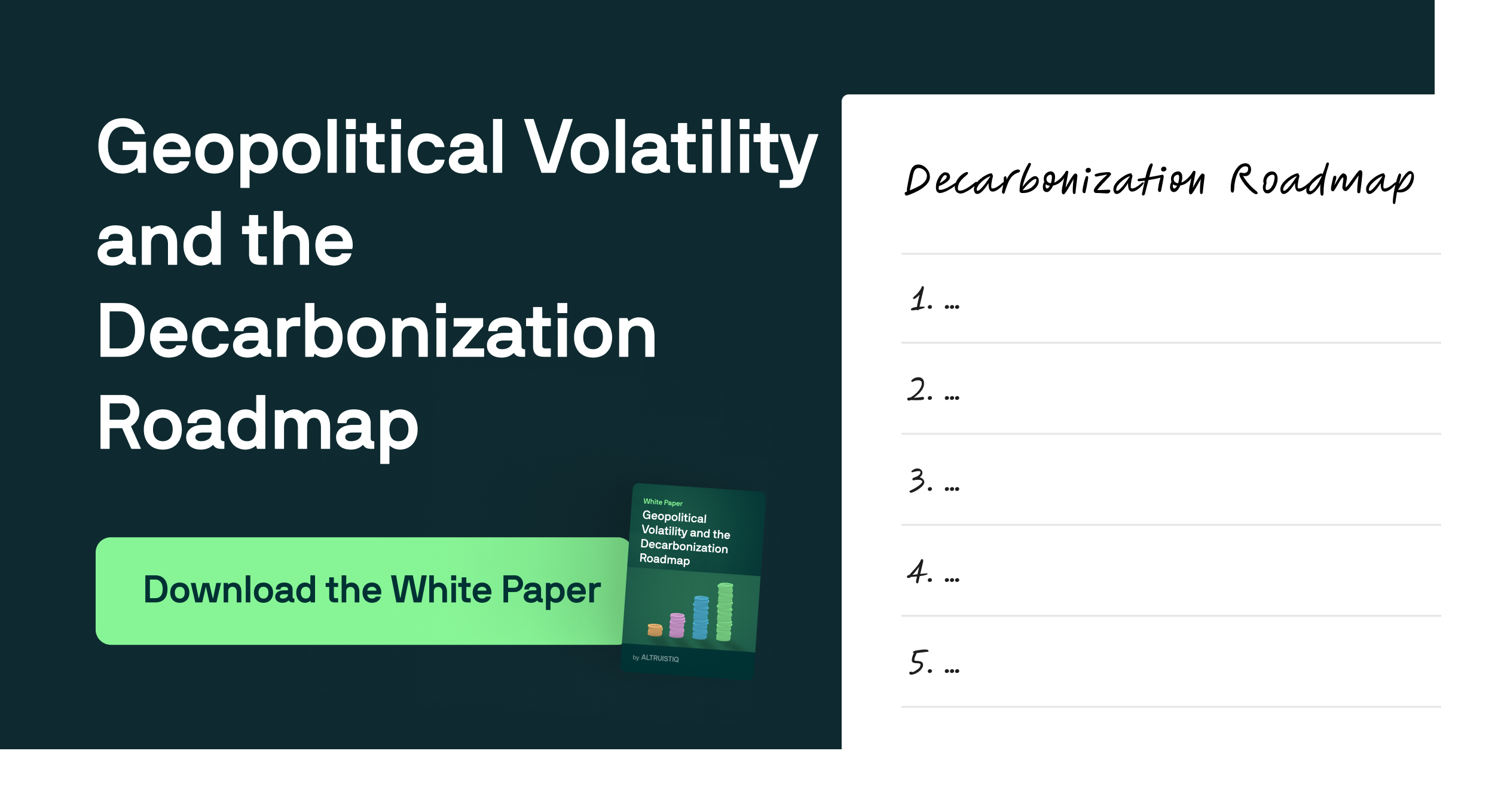
Geopolitical Volatility and the Decarbonization Roadmap: A Marginal Abatement Cost Analysis of Sustainability Initiatives for the CPG Sector Following the 2026 Iran Conflict
The Iran conflict has flipped the economics of sustainability. Renewable PPAs and fertilizer optimization have crossed into negative-cost territory; the green option is now cheaper than the fossil-fuel baseline.
rPET and EV fleets have reached a tipping point. Oil-driven cost inflation has erased the "green premium" on recycled packaging and electric trucks for the first time in industry history.
Zero-deforestation is the one casualty. Shipping reroutes and war-risk insurance have made identity-preserved supply chains six times more expensive, putting net-zero agricultural commitments under serious strain.

Three New Features to Know Your Numbers and Explain Them to Anyone
- Full traceability on your emissions data: change logs, validation checks, and an interactive programme tracker give teams the context and control to manage footprints end-to-end
- Customer-ready PCF reports in minutes: generate framework-compliant PACT, PEF, and ISO 14067 documents directly from your product footprint data, no manual reformatting required
- FIrst look at Evie: Altruistiq's AI sustainability analyst, built into the platform to help teams clean data, explore workbooks, and get answers grounded in their domain
Blue State Pincer: how New York and California closed ranks on US climate legislation
The regulatory pincer is real — California and New York together effectively capture any meaningful American business; federal rollbacks at the SEC level are largely beside the point.
New York's macro track casts a wide net — just $1M in state revenue qualifies as "meaningful business," pulling in companies far beyond their HQ location, including whole conglomerates via subsidiaries.
New York is more durable than CSRD — single-state control, a high revenue threshold, a narrow emissions-only focus, and a built-in citizen lawsuit mechanism make it far harder to roll back than EU legislation.
Scope 3 data requests will cascade downstream — once large companies are forced to disclose, expect pressure to ripple through supply chains, pushing smaller suppliers to improve data quality too.
Slow and steady beats fast and backlashed — the DEI rollback is a cautionary tale; legislation that moves too far too fast triggers reactions that leave things worse than before.

Get it while it's hot: Why McKinsey calls adaption a ''buy'', and how to sell it to the CFO

The 2026 Bear-Market for Green Jobs: Why You Need to Be Anti-Fragile
The sustainability function is being absorbed, not eliminated — most of the work is migrating into procurement, supply chain, and finance, not disappearing entirely.
Be antifragile, not just resilient — build hard, transferable skills (data, insights, stakeholder management) that are most valuable precisely when things go wrong.
In corporates, follow the margin — high-margin companies in pharma, personal care, flavours, and fragrances are the most committed and resourced to sustain the function long term.
Consulting is shrinking, software is consolidating — both are riskier bets right now; wait for the software market to consolidate before picking a side.
Nonprofits may be a hidden opportunity — after two bruising years, many have reset and stabilised; the need for honest brokers bridging corporations and governments isn't going away.
No items found
No items match your search criteria. Try another search.
Browse by channel


Questions, feedback or content suggestions?
Get in touch with the Altruistiq team
